
Australia’s Submarine Gamble
AUKUS, the Virginia-class bottleneck, and the risk of a capability gap

Australia finds itself in a precarious strategic position. Four years after the final boat in the class was commissioned, the requirements for the successor to Collins were defined in the 2009 Defence White Paper. It was a further six years before the government announced an evaluation process of designs from Japan, France, and Germany. Just over a year later in 2016, the Attack class, a conventional variant of the French Suffren class by DCNS, now known as Naval Group, was selected.
Given the project’s scope and complexity, and the notoriously lethargic pace of Australian defence procurement, this was late in the process. By that point, HMAS Collins was already over 20 years old and expected to remain operational for only another 10 years. It wasn’t too late, but construction of the Attack class needed to commence quickly if the first-in-class boat was to be ready in time for the retirement of Collins.
What followed was five years of design work and delays that meant, at best, HMAS Attack would not be ready to enter the fleet until at least 2030, with further delays a virtual certainty. This was especially true for a first-in-class boat, with memories of the early Collins issues still fresh.
The argument between conventional and nuclear propulsion will not be relitigated here, but suffice it to say that in 2021, Australia cancelled the contract with Naval Group for the Attack class and announced a trilateral security partnership with the United States and United Kingdom, known as AUKUS. This would include the purchase of three to five Virginia-class boats, while a joint partnership between Australia and the UK would lead to the design and construction of a new class of nuclear attack boats, with Australia expecting to build five.
Another five years later, and the AUKUS agreement remains in place. Work at HMAS Stirling is proceeding ahead of the establishment of the Submarine Rotational Force-West in 2027, one of the key requirements Australia must fulfil to demonstrate our capacity to operate nuclear boats. Two US Navy submarines visited in 2025, and more recently we hosted the Royal Navy’s HMS Anson, an Astute-class submarine. Finally, in February 2025, Deputy Prime Minster Richard Marles confirmed that Australia had sent the first payment of US$500 million of a total of US$3 billion to invest in the US industrial base to help them build boats faster.
It was reported that two used Virginia-class Block IV boats would be sold to Australia in 2032 and 2035, with a new build Block VII to follow in 2038. Then the new class, dubbed SSN-AUKUS, would enter service in the RAN beginning in the early 2040s.
Consequently, the Royal Australian Navy submarine community faces an imminent capability gap. The Life of Type Extension (LOTE) should help prolong the useful lives of existing boats. However, even in best-case scenarios, Collins will be 36 years old when the first Virginia enters service, and if decommissioning continues as nuclear boats enter service, the last Collins-class boat, HMAS Rankin, could still be in service in 2048 when she will be 45 years old.
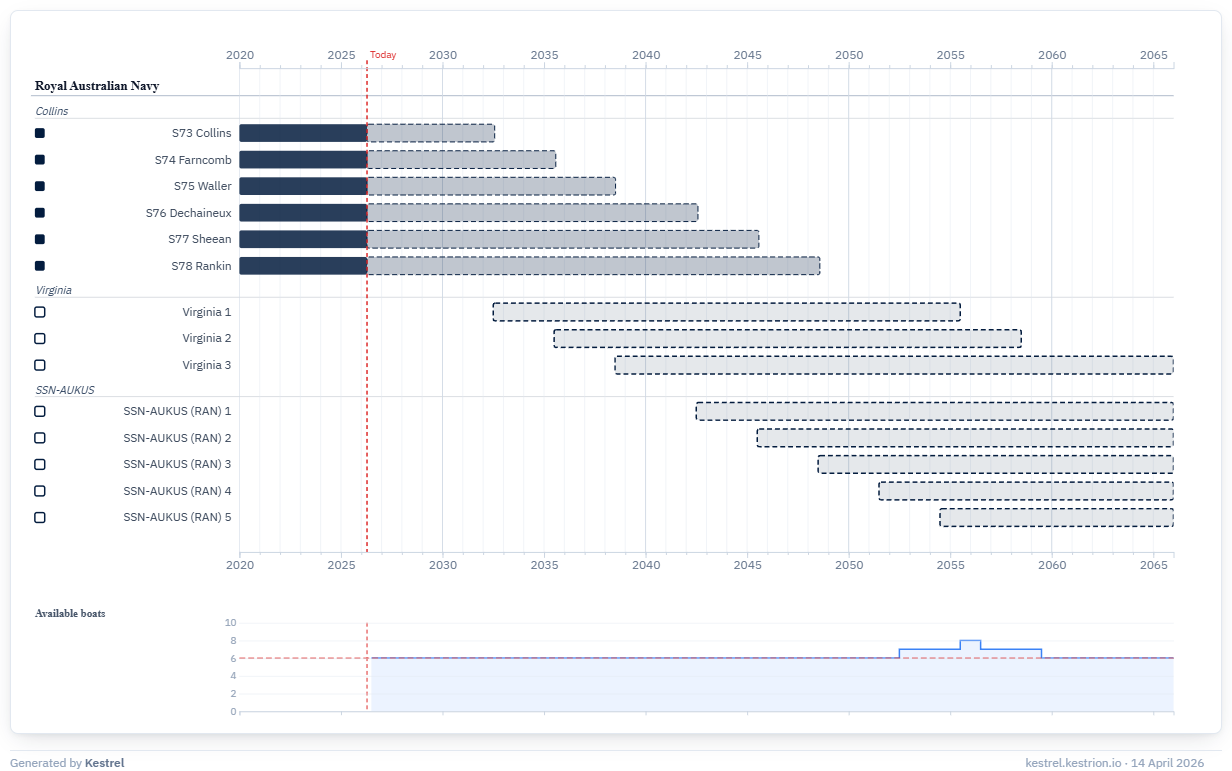
Even when viewed in isolation, Australia faces a crisis on multiple fronts. Our boats are aging, defence procurement and maintenance cycles tend to be delayed and cost more than anticipated, and we are at least six years away from the first RAN Virginia.
In theory, we can hold on. The LOTE across the fleet could be completed on time, corrosion issues may be sufficiently ameliorated, and the challenge of operating three different classes of boat may not prove prohibitive. We only need to bridge the gap for a few more years.
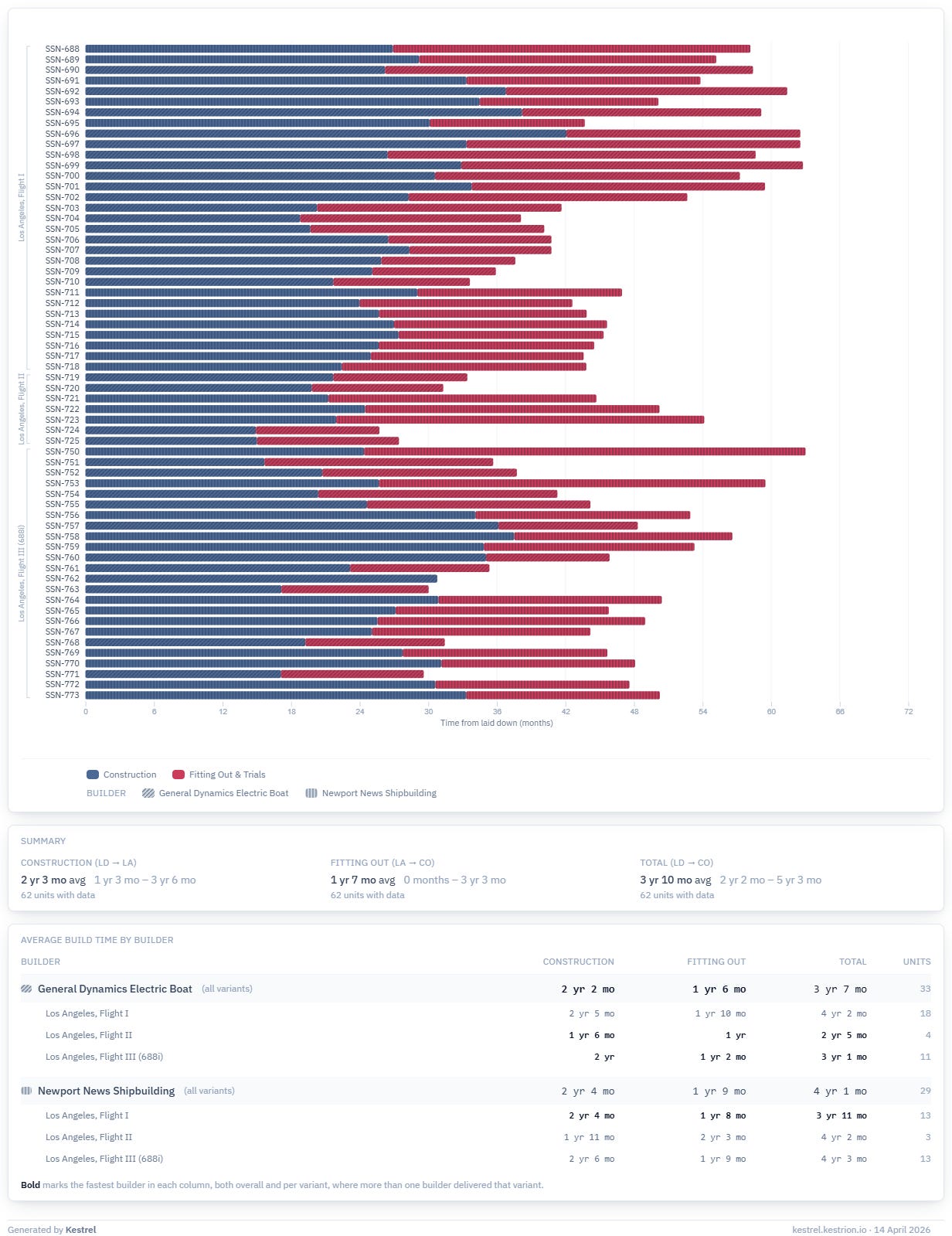
But that ignores the continuing challenges in US naval shipbuilding. The Los Angeles-class boats are reaching the end of their lives, and they were built at such a pace that US shipyards cannot replace them with Virginias quickly enough to compensate. In 20 years between 1976 and 1996, 62 boats of the class were commissioned into the United States Navy, an average of 3.1 per year. Across the class, the average time from keel laying to commissioning was 3 years and 10 months.
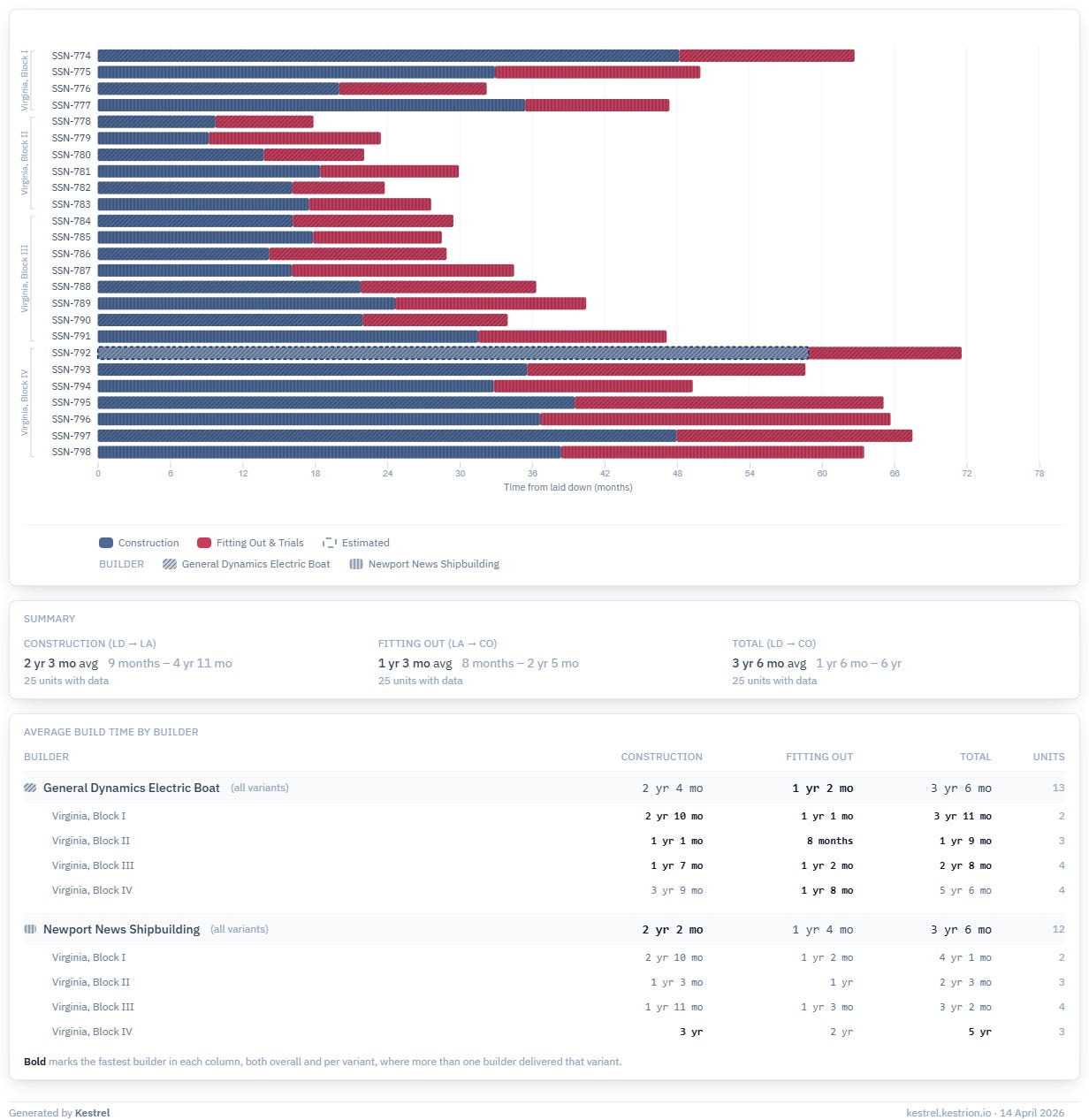
Now compare that to the Virginia-class. It has been 22 years since USS Virginia was commissioned, and in that time the US Navy has commissioned only 25 boats, with Idaho due to join the fleet later this month1. On average, time from keel laying to commissioning is shorter at 3 years and 6 months, but this obscures the fact that Block IV boats have taken significantly longer to build than the earlier Block II and III. Of the seven Block IV boats currently in active service, the average time to commissioning is over five years. The added complexity of the Virginia Payload Module in Block V and VI boats is likely to place further pressure on production.
This means that not only is the US attack submarine force contracting, it is also getting older. When viewed in isolation, this is already a cause for concern. The ultimate failure of the Seawolf class to replace the Los Angeles class delayed the transition to the Virginias. However, by 2004, they were beginning to enter service, so there was reason to believe this would not lead to a major reduction in US undersea capability. That has not been the case.
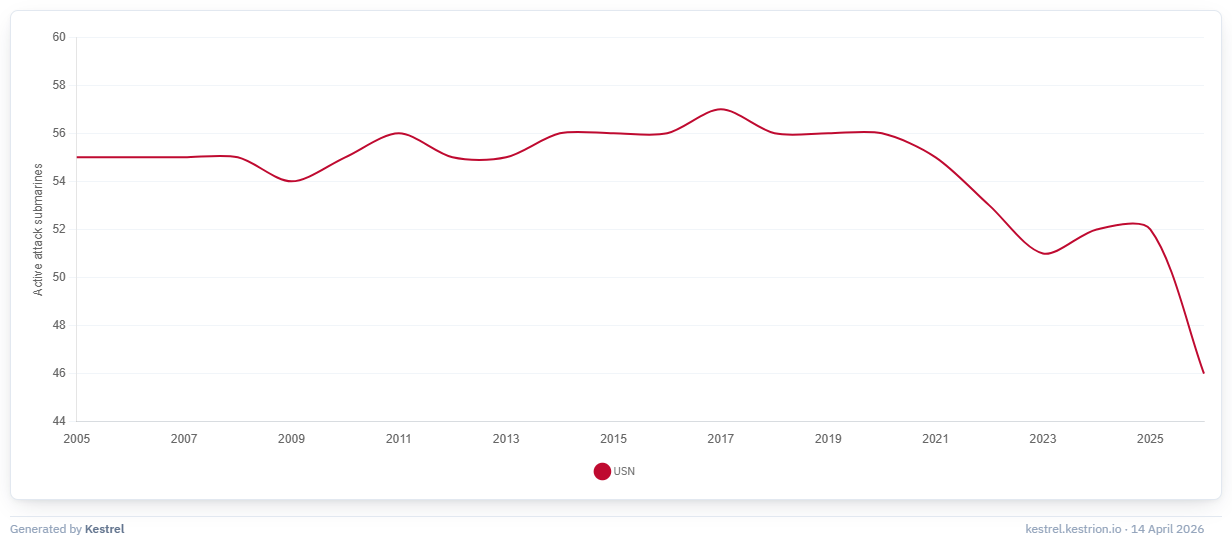
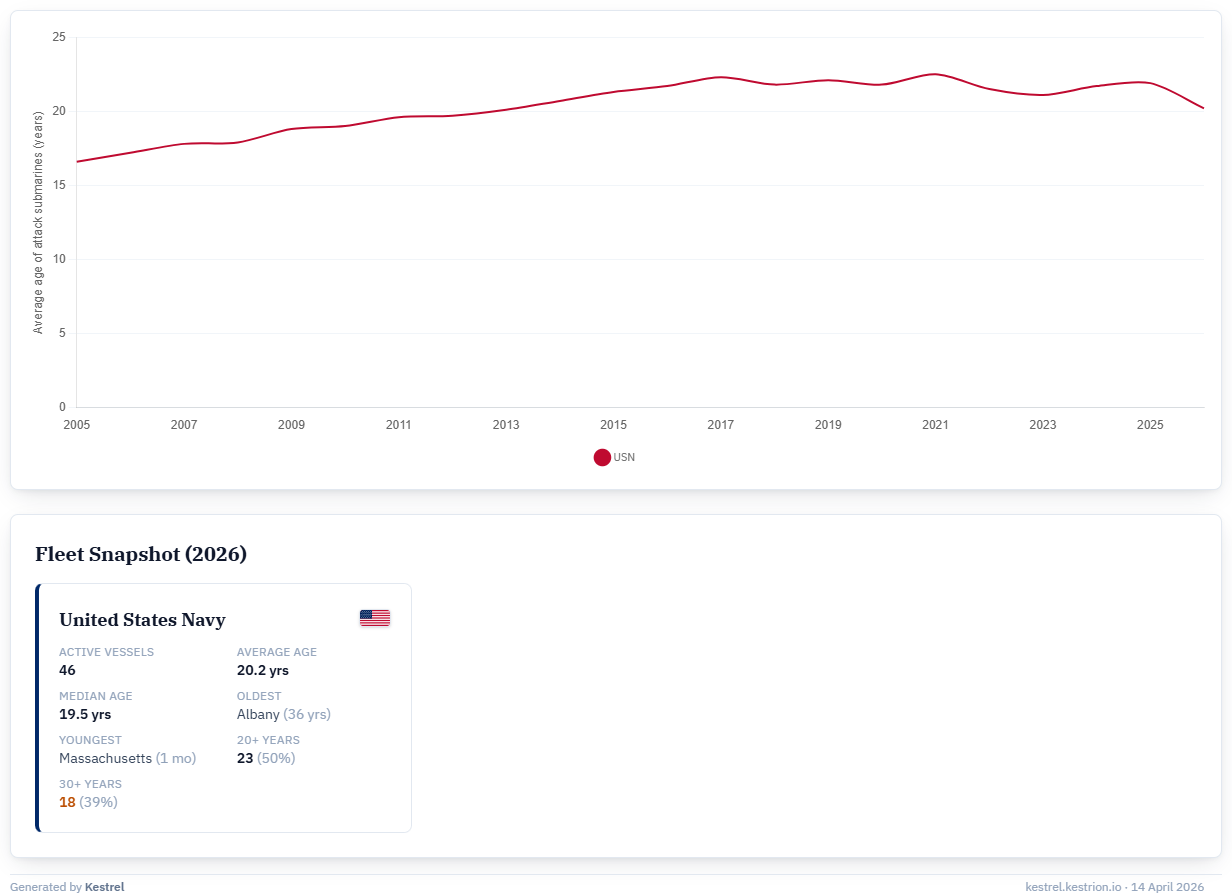
As I mentioned earlier, US shipyards have not been able to replace their aging boats quickly enough so that by 2005, the average age of the US Navy’s 55 then active attack submarines was 16.6 years. As of early 2026, its 46 active boats average 20.2 years of age. Fifty per cent, or 23 boats, are over 20 years old. Most alarmingly, 39.1 per cent, or 18 boats, are over 30 years old and rapidly approaching the end of their lives.
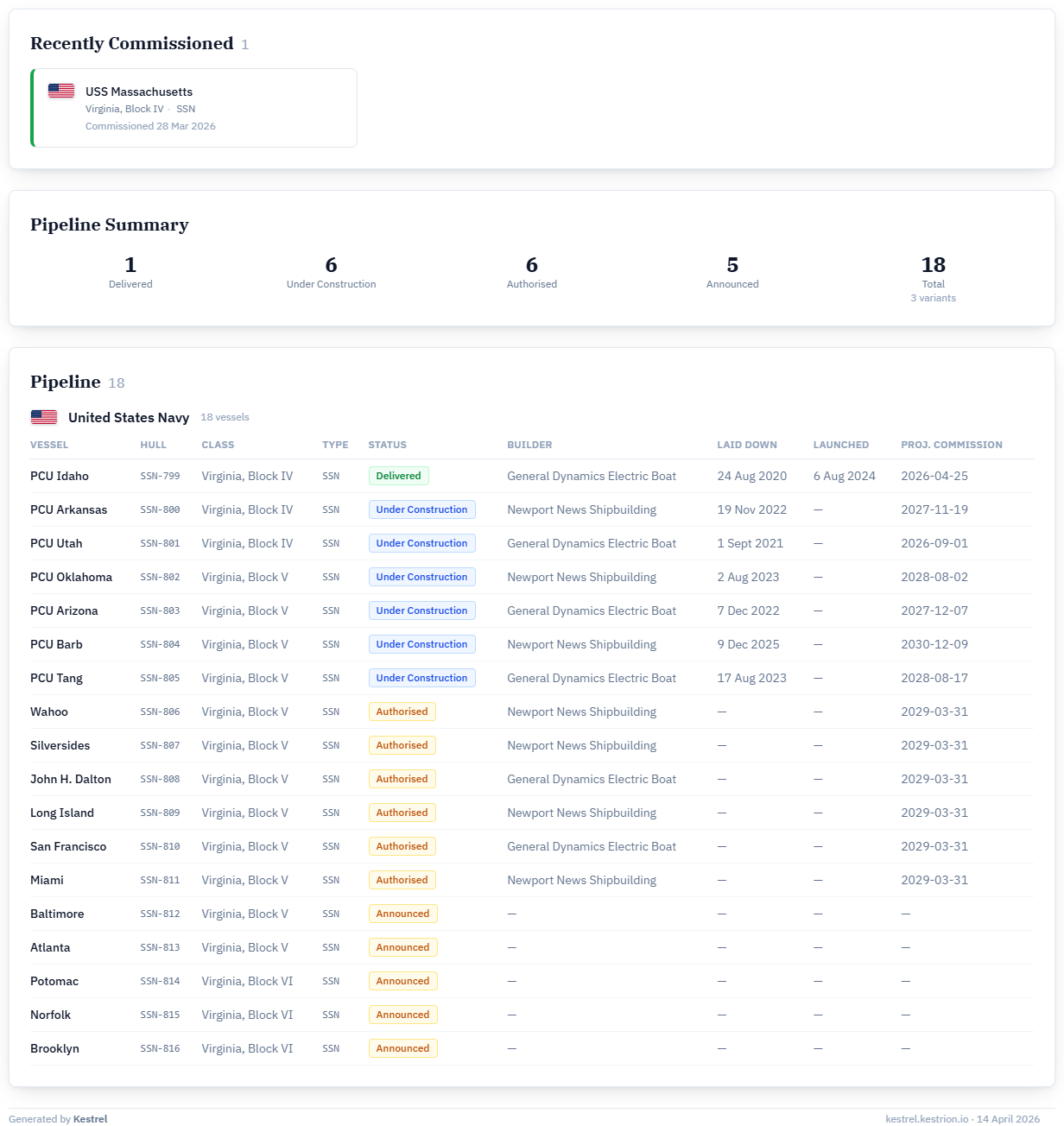
With Idaho already delivered, six more Virginias under construction, and another 11 in planning, the pipeline appears robust at first glance. However, the timing matters. As Los Angeles-class boats continue to retire, new construction has not kept pace, and the US submarine fleet will continue to contract before it begins to grow again.
This is compounded by ongoing maintenance issues that only recently forced the Navy Department to Inactivate the 688i-class USS Boise. She had languished alongside for a decade while waiting for a shipyard slot, and with what it would cost to get her back to sea when she is already over 33 years old, it did not make economic sense to persevere. However, that means there is one less boat for a force that has been spread painfully thin for many years and is close to reaching a tipping point.
This leaves Australia in a predicament. For the sale of Virginias to proceed, the US President must certify to Congress that it will not degrade the Navy’s undersea capabilities. Despite the money being poured into US shipyards, the rate of new boat construction remains stubbornly low.
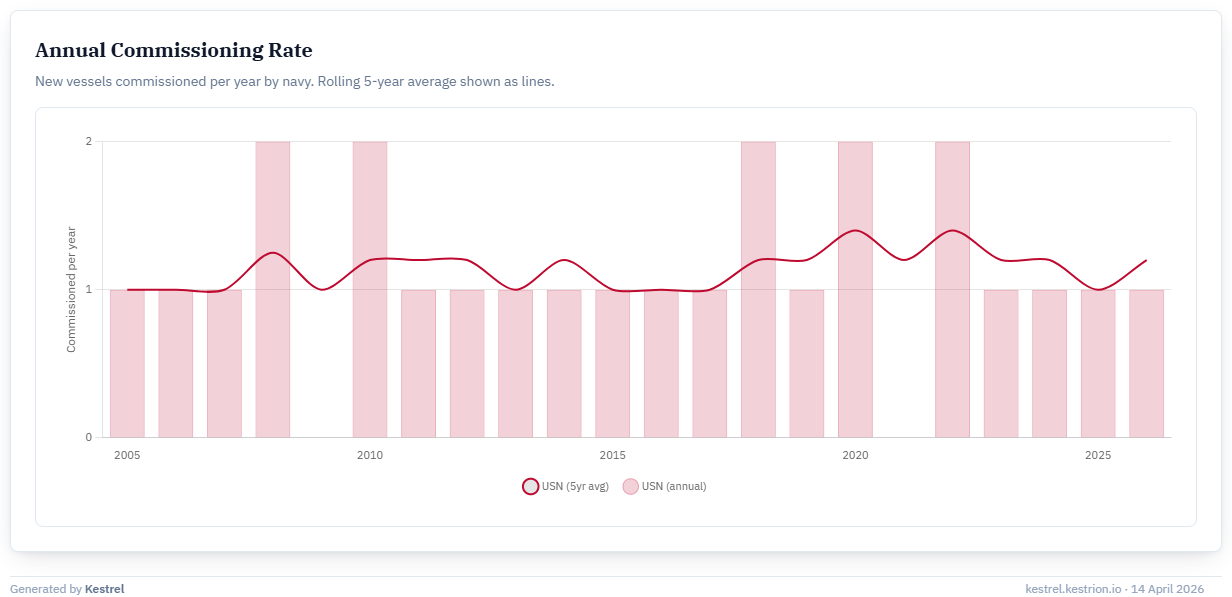
There is still time, of course. If the US can successfully increase its commissioning rate from the current 1.2 to the target of 2.33 boats per year, then the President can credibly certify that the sale will not degrade US undersea capability. Ideally, they would hit it by 2030 because, as the Los Angeles class continues to decommission, shipyards need time to build enough boats to not only cover those losses but also begin growing the fleet again.
That is the real danger. For better or worse, Australia jettisoned the Attack class, and that leaves us vulnerable. We must make AUKUS and the Virginia class sale work because if it falls through, Australia will imperil its submarine capability. It would also put the SSN-AUKUS boats in jeopardy, as we would likely lose much of the RAN’s qualified submarine workforce. The adage of fleets taking decades to build but minutes to destroy holds true when it comes to qualified personnel and institutional memory.