
HMS Dragon Enroute to Cyprus
But when will she arrive?

Earlier today the Royal Navy announced that HMS Dragon had departed Portsmouth enroute to Cyprus, roughly 10 days after an Iranian drone struck RAF Akrotiri.
Many arguments can and have been made about the time taken for the British Prime Minister to order the departure of Dragon, a Type 45 destroyer, and even how long it took for the ship to sail after that order was given. Those debates are beside the point. Dragon has now sailed. The real question is how long until she arrives?
I created the Ship Routing Tool to help model this exact sort of scenario; estimating how long a vessel might take to complete a particular transit using different speed assumptions.
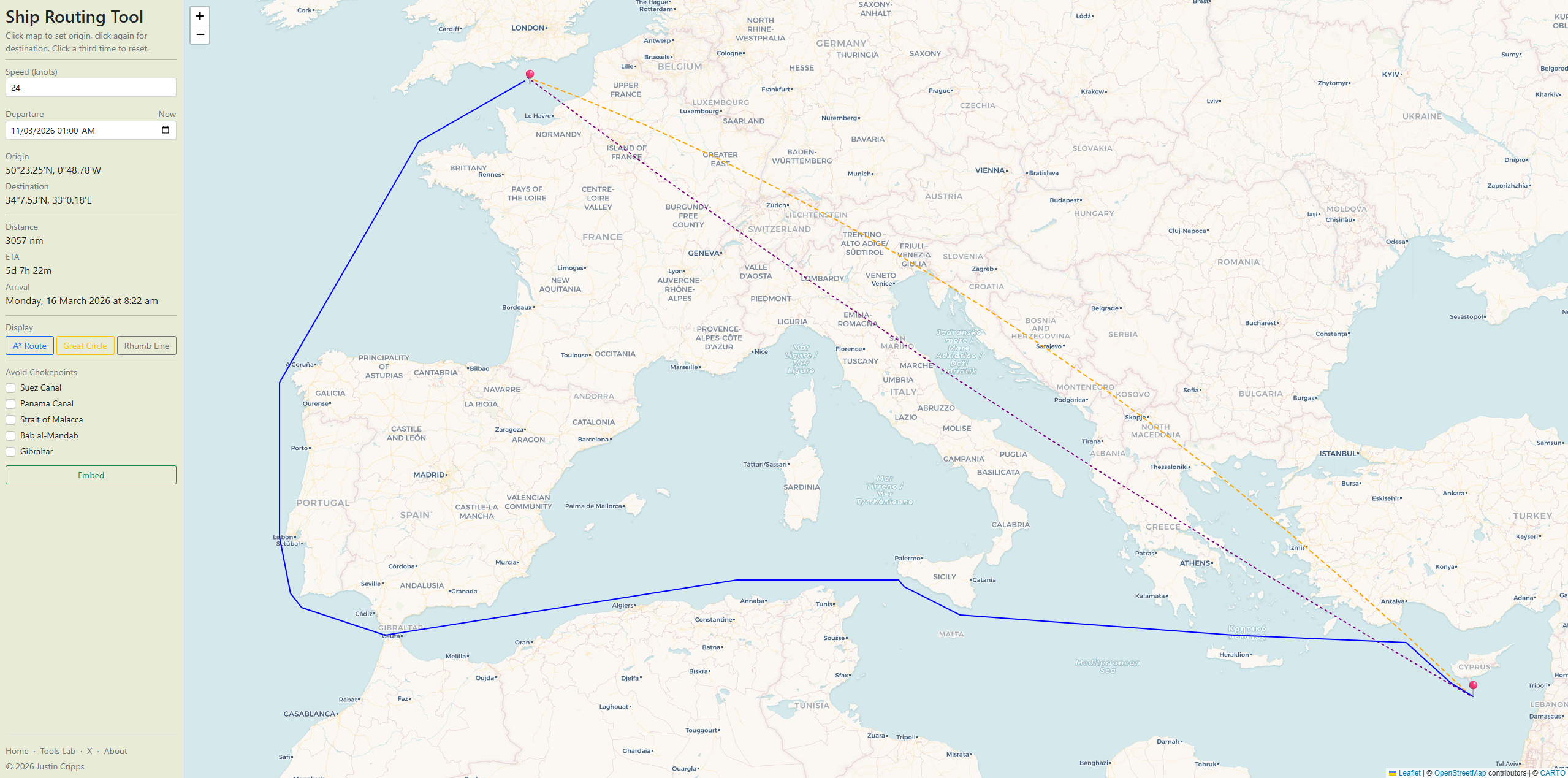
Dragon departed HMNB Portsmouth earlier today. I do not have a precise departure time, so the estimates below are based on the time the Royal Navy announced the sailing. That announcement came at roughly 3 pm, and photographs of Dragon leaving harbour show the departure taking place during daylight hours. Given the British weather, however, it is difficult to be any more precise than that.

Cyprus is roughly 3,000 nautical miles from Portsmouth when transiting through Gibraltar.
The Type 45 has a publicly stated range of more than 7,000 nautical miles at 18 knots. Given the circumstances and the need to arrive on station quickly, Dragon will almost certainly operate well outside of its most economical cruising profile. The question is how much faster.
Using my tool, I ran several scenarios.
At 16 knots, the transit would take roughly 7 days and 23 hours, producing an arrival around Wednesday 18 March at approximately 4 pm.
At 22 knots, transit time drops to 5 days and 18 hours, placing arrival on Monday 16 March at around midday.
At 24 knots, the voyage shortens further to 5 days and 7 hours, with arrival just after midnight on Monday 16 March.
A faster transit is certainly possible. However, speed comes with a cost and that is fuel consumption.
A useful rule of thumb in naval engineering is that propulsion power rises roughly with the cube of speed, which means fuel consumption per nautical mile increases roughly with the square of speed.
Put more simply, pushing a warship faster rapidly reduces its range.
If Dragon were to maintain 24 knots, her effective range could fall to around 4,000 nautical miles. Subtract the 3,000 nautical mile journey to Cyprus and the ship would arrive with a relatively small fuel margin.
UPDATE: Want to see how I arrived at this figure? I polished my calculator and uploaded it. Check it out here.
There have been no reports of a Tide-class replenishment tanker sailing with Dragon or one already on station somewhere in the central of eastern Mediterranean, so it is safe to assume that she will refuel prior to arrival. I assume most likely in Gibraltar, but it is possible she will refuel somewhere closer to Cyprus.
Refuelling alongside in port typically adds four to eight hours to a transit. Even accounting for that stop, however, a faster passage remains attractive. A 24-knot transit with a refuelling stop would still arrive roughly two days earlier than a more economical 16-knot passage.
In other words, while the exact speed profile is unknown, the broad parameters are clear: Dragon will almost certainly trade fuel efficiency for time, with a refuelling stop somewhere along the route.
Naval deployments often appear glacial from the outside, but even small differences in sustained speed can shift arrival times by days. It is a reality that planners must constantly balance against fuel consumption and logistical risk.
What happens then is anyone’s guess.
If you would like to experiment with the numbers yourself, you can try the Ship Routing Tool here and if you found this article or the tool useful, please consider subscribing.